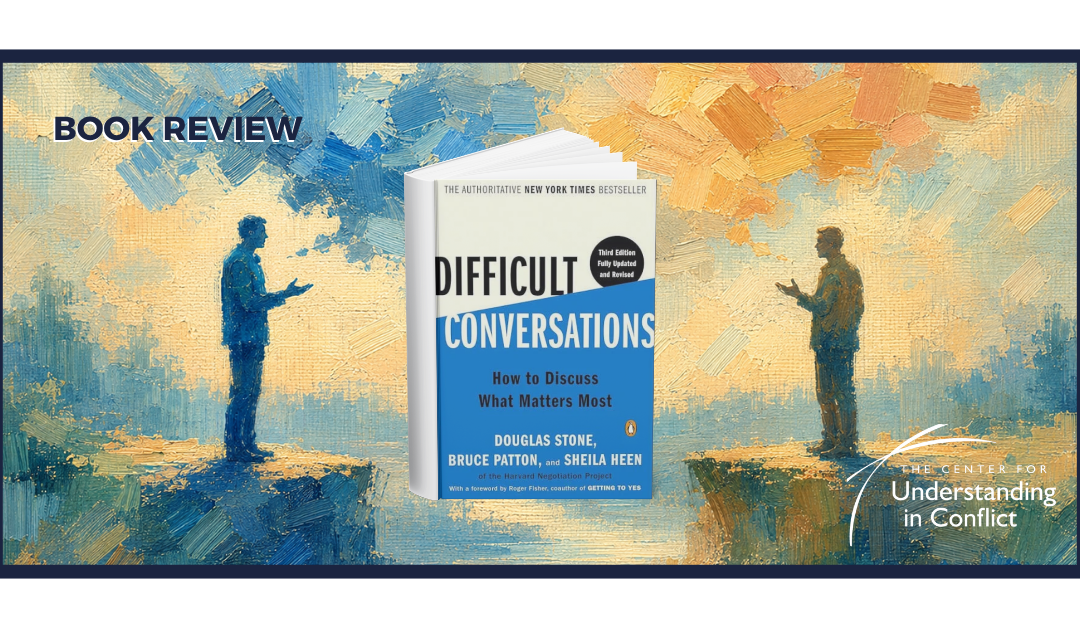
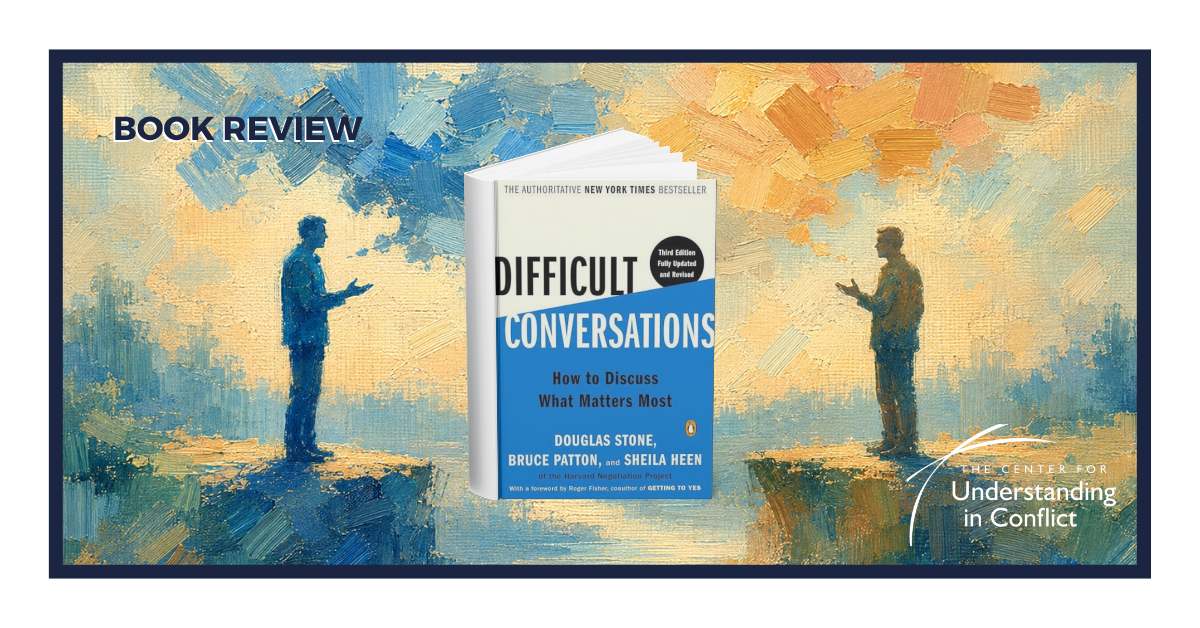
A colleague has disappointed us. A family member has hurt us. A decision feels unfair. We need to give difficult feedback, acknowledge a mistake, ask for something important, or respond to a story about ourselves that we do not recognize. Difficult Conversations begins from the reassuring premise that these conversations are difficult not because we are unusually bad at them, but because they involve deeply human concerns about truth, emotion, dignity, belonging, and identity.
Drawing on the authors’ work with the Harvard Negotiation Project, the book speaks to a nearly universal experience: the conversation we avoid because too much seems to be at stake. This starting point resonates strongly with the understanding-based approach to conflict. Both invite people to move away from certainty and judgment and toward curiosity. Rather than asking, “How do I prove that I am right?” they encourage us to ask, “What am I missing?” and “What is important to each of us?”
Difficult Conversations’ central framework proposes that every difficult conversation contains three overlapping conversations: the “What Happened?” conversation, the feelings conversation, and the identity conversation. This framework is valuable because it helps us notice that an argument about events is rarely only about events. Beneath disagreements about who said what or who failed to act may be feelings of disappointment, fear, anger, shame, or exclusion. At an even deeper level, the conflict may threaten how we understand ourselves. Am I competent? Am I trustworthy? Am I a good parent, colleague, partner, or friend?
For understanding-based practitioners, this movement below the surface will feel familiar. Conflict becomes more workable when people can understand not only positions and preferred outcomes, but also the experiences, meanings, emotions, and values beneath them. The authors’ distinction between intention and impact is especially helpful. We often judge ourselves by what we intended while judging others by the impact of their actions. Recognizing that both intention and impact matter creates room for accountability without requiring us to label another person as malicious.
The book’s shift from blame to contribution also aligns with the understanding-based commitment to party responsibility. Asking how each person contributed to a situation can open possibilities that blame closes. Contribution is not the same as equal responsibility, nor does it excuse harmful conduct. It is an invitation to identify the patterns, choices, assumptions, and interactions that may be sustaining a conflict.
This distinction deserves particular care when significant differences in power, safety, or authority are present. Some harms are not mutual, and responsibility should not be artificially balanced. Understanding another person’s experience does not require agreement, forgiveness, or the abandonment of accountability. Here, the understanding-based perspective can deepen the book’s framework by placing communication tools within a fuller assessment of relationship, context, power, and the parties’ capacity to participate meaningfully.
There are other differences in emphasis. Difficult Conversations is primarily a guide for individuals preparing to enter challenging exchanges. The understanding-based model is also concerned with the process the parties create together. It asks how people can remain in direct conversation, develop a more complete understanding of their situation, consider legal and practical realities where relevant, and make decisions that genuinely belong to them.
Difficult Conversations’ offers techniques, including beginning from a neutral “third story,” listening for what matters, and replacing either-or thinking with a more inclusive “and” perspective. These are useful practices, but CUC practitioners may also recognize that no set of phrases can substitute for presence. A conversation can follow all the recommended steps and still feel managed rather than human. Genuine understanding requires patience, humility, emotional steadiness, and a willingness to be changed by what we hear.
Ultimately, the book and the understanding-based approach share a hopeful view of conflict. Neither promises that every relationship can be repaired or every disagreement resolved. Instead, both suggest that people can engage conflict with greater honesty, dignity, and compassion. We can become less invested in defending a fixed story and more capable of hearing complexity. We can name impact without claiming certainty about intention. We can take responsibility without accepting blame that is not ours.
For trainers, mediators, and practitioners, Difficult Conversations offers accessible language for concepts we regularly encounter in our work. For clients, colleagues, friends, and family members, it provides a practical invitation: do not enter the conversation to win the story. Enter it to learn what the story has not yet allowed you to see.