
Demystifying California Family Law
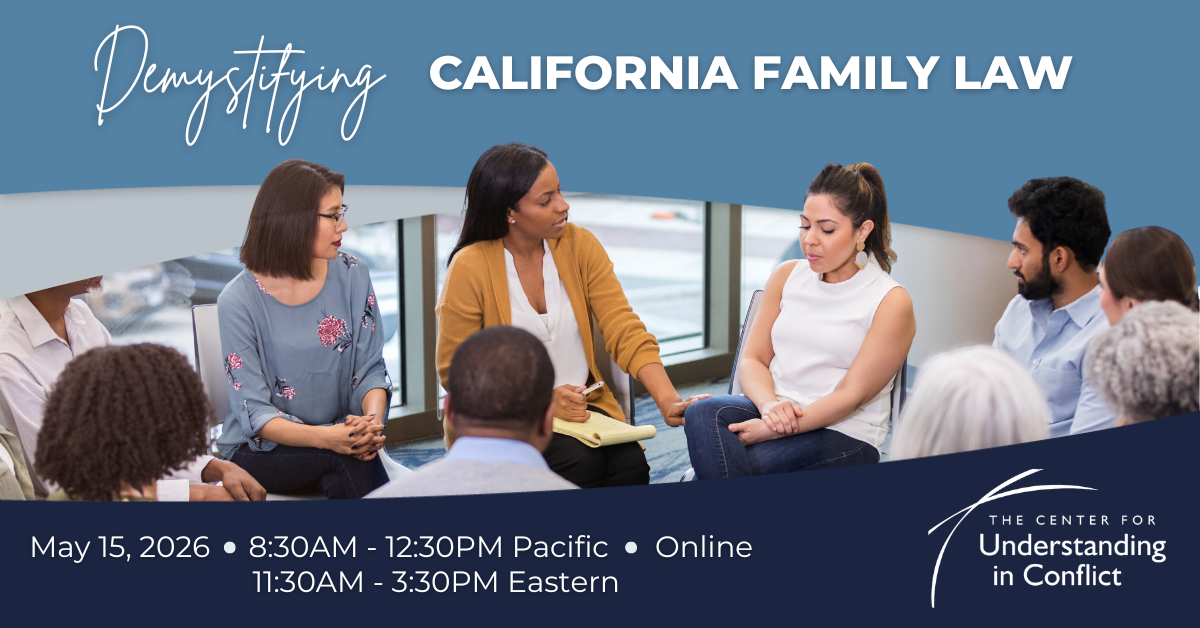
Navigating family law can be challenging for professionals outside the legal field, even those with experience working alongside divorce and custody cases. This workshop is designed to bridge that knowledge gap, offering both newcomers and experienced practitioners a clear, practical overview of California Family Law as it applies to their work. Led by a psychologist-mediator and an attorney-mediator, participants will gain essential insights into the legal issues most commonly encountered by non-legal professionals — such as community property, custody arrangements, support obligations, the documentation of agreements, and general court requirements.
Through real-world examples and discussion, attendees will learn how family law impacts their professional roles and client relationships. The ultimate goal of this workshop is to empower professionals to confidently engage in family law contexts, fostering stronger collaboration and understanding between legal and non-legal disciplines.
Why This Training
Professionals who work with divorcing, separating or non-cohabiting couples and families often find themselves navigating complex legal systems without formal training in family law. This can lead to uncertainty, confusion, and missed opportunities to best support clients. This workshop helps bridge that gap, offering a clear, practical understanding of California Family Law as it intersects with your professional work.
With a focus on real-world application, this training empowers participants to engage more confidently and ethically in family law contexts — whether in a clinical, advisory, advocacy, or consulting capacity.
What You’ll Learn
Using real cases, discussion, and applied examples, this workshop will help participants:
- Understand the structure of the California family law system
- Identify how property division, custody, and support obligations affect your work with clients
- Gain clarity on how agreements are documented and how the court system functions
- Learn the boundaries and ethical considerations for non-legal professionals in family law matters
- Understand how your professional role intersects with — and is shaped by — California family law
- Build collaborative bridges with legal professionals while maintaining your own professional integrity
Who Should Attend
This training is for any professional who works with families navigating divorce, custody disputes, or other family law matters — and who wants a clearer understanding of the legal landscape without a law degree. This includes therapists, counselors, psychologists, financial advisors, coaches, educators, school counselors, social workers, advocates, mediators, and other consultants who regularly interface with separating families.
- Therapists and counselors will learn the basics of family law as it affects their clients, considering marriage, separation and divorce as well as parenting issues in two separate households.
- Financial and advisory professionals will gain a framework for how property division and support obligations are structured, helping them guide clients within realistic legal boundaries.
- Coaches, educators, and advocates will develop a clearer picture of the court system and how family law decisions affect the families they serve.
- Mediators and collaborative professionals will benefit from the presenters’ integrative approach that honors both psychological and legal perspectives, creating space for more durable and child-centered outcomes.
- Newer professionals will leave with a foundational orientation, while seasoned practitioners will deepen their understanding and clarify the limits and possibilities of their roles in legal processes.
Why It Matters
Non-attorney professionals are often a critical part of the support system during divorce and custody disputes — but without legal fluency, their contributions can be undermined or misunderstood. This training helps ensure that participants can:
- Reduce ethical risk and confusion in their practice
- Support clients with informed, grounded guidance
- Improve outcomes for children and families in transition
- Collaborate more effectively with attorneys and the courts
Participants will leave with knowledge that is immediately applicable in their work — whether in therapy, mediation, financial planning, coaching, or consultation — and a stronger foundation for navigating the increasingly interdisciplinary world of family conflict.
Note: This is a broad-strokes orientation, not legal advice. In just four hours, participants will gain a working familiarity with key concepts to support their professional roles — and a clearer sense of when and how to collaborate with legal counsel.
Format & Details
Date & Time: Friday, May 15, 2026 8:30 a.m. – 12:30 p.m.
Location: Live Online (Zoom)
Cost: $150
About the Center
The Center for Understanding in Conflict pioneered understanding-based mediation and is one of the first and only nonprofit conflict resolution training organizations worldwide.
Since 1982, the Center has trained more than 10,000 professionals worldwide, including leaders from the Harvard Law School Program on Negotiation, Intel Corporation, Roche, SAP and the World Intellectual Property Organization. Our approach is rooted in real-world practice, human connection, and the belief that conflict can be a doorway to transformation.
Presenters
 Stacey Shuster, Ph.D. is a psychologist-mediator in private practice in the Bay Area. Trained as a couple, family, and child therapist, she has taught Family Therapy in various graduate programs, including the Department of Psychiatry at California Pacific Medical Center. Stacey supports separating and divorcing families as a mediator, co-parent counselor, and divorce coach. A frequent national presenter, she offers consultation on same-sex divorce, co-parenting challenges, and Integrative Mediation to attorneys and mental health professionals.
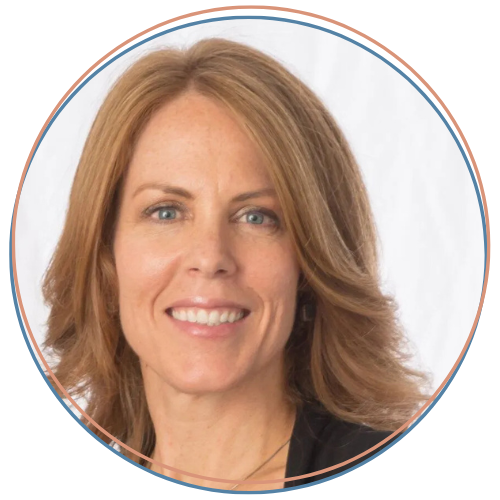 Paula M. Lawhon, J.D. is a Certified Family Law Specialist and full-time family law mediator based in Marin County. With over 20 years of experience mediating family law cases and a background in civil and family litigation, Paula brings deep legal knowledge and a collaborative spirit to her work. She earned her J.D. from UC Law San Francisco (formerly UC Hastings) in 1999 and her B.A. from UC Irvine in 1996, graduating cum laude and Phi Beta Kappa. Paula regularly presents and writes on family law mediation and integrative dispute resolution models.
Additional Notes
Registrations received fewer than 72 hours before the program will be accepted at the discretion of the training team due to role-play and logistics needs.
For questions, contact us at [email protected]
**Please select desired ticket and quantity using the +/- feature before clicking ‘Get Tickets.’