
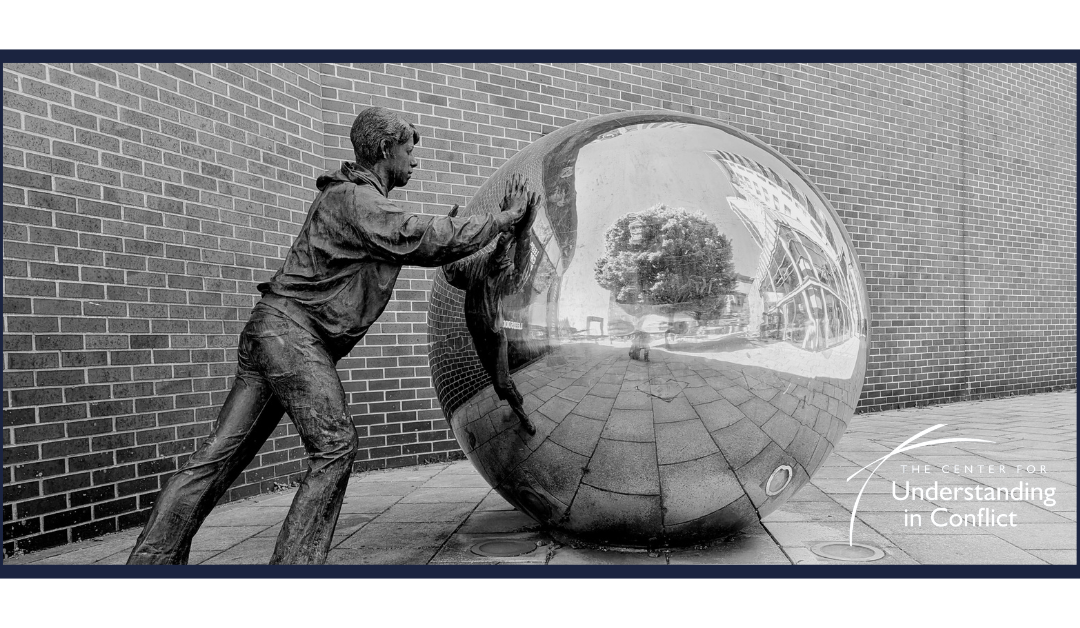
People who choose to work with conflict often do so from a place of deep care. Something in them is drawn toward human struggle, repair, dialogue, and the possibility of movement where others see only “stuckness.” That commitment is meaningful, but it is not simple. The work of supporting people in conflict does not ask only for skill or good intentions. It asks for ongoing self-reflection and the willingness to stay in relationship with others who are engaged in that same effort.
Self-reflective practice matters because conflict work is never only external. Even when our attention is on clients, colleagues, or communities, we are always bringing ourselves into the room. We bring our histories, our identities, our hopes, our fears, our assumptions, and our learned ways of responding to tension. We bring the parts of ourselves that long to help, protect, guide, fix, or soothe. If we do not make space to understand these deeper impulses, they can quietly shape our work in ways we do not fully see.
For many practitioners, the desire to work with people in conflict is rooted in something personal as well as professional. Some know conflict intimately from their own lives and feel called to help others find a different path. Some are moved by a longing for justice, dignity, or connection. Some are trying, consciously or not, to repair something in the world that has caused harm in their own experience. None of this is a problem. In fact, these deeper motivations often contain the heart of one’s commitment. The challenge is not that they exist, but that they can remain unexamined.
Self-reflective practice creates a way to compassionately connect with and understand those inner drivers. It allows us to ask not only what we do in conflict, but why. Why do certain interactions pull so strongly on us? Why do we feel especially protective of one person’s experience over another’s? Why do we become activated by certain tones, stories, or dynamics? Why do we sometimes feel compelled to move the conversation in a particular direction? These questions are not meant to produce shame or self-criticism. They are invitations to greater honesty and depth.
That honesty becomes even more important when we consider the many histories, positions, and intersections we each carry. No one comes to this work from a neutral place. Our social identities, cultural backgrounds, class experiences, family systems, and professional roles all affect how we interpret conflict and how others experience us. Self-reflective practice helps us become more aware of those influences, not so we can erase them, but so we can relate to them with humility and care. It helps us recognize that our perspective is shaped, partial, and alive with meaning.
This kind of practice also brings us face to face with barriers to self-understanding and constructive presence. General reactivity is one of the most common. When tension rises, we may become mentally flooded, emotionally contracted, or overly certain. We may judge quickly, withdraw inwardly, or feel an urgent need to regain control. Insecurity can show up as overpreparing, overperforming, or needing to be seen as competent and helpful. Anger can narrow our field of vision and harden our responses. Judgment can distance us from the very people we are trying to support. The desire for control can quietly replace curiosity with management.
These barriers are deeply human. They do not mean we are unsuited for conflict work. They mean we are people doing demanding work that touches vulnerable places in us. The goal of self-reflective practice is not to eliminate every difficult response. It is to notice them sooner, understand them more deeply, and work with them in ways that bring us closer to ourselves rather than further away.
That compassionate turning toward ourselves is essential. If we only meet our reactivity with criticism, we tend to become more defended, not more open. If we judge our insecurity harshly, we often deepen the very fear we are trying to overcome. But when we can slow down and meet those barriers with interest and steadiness, something shifts. We begin to see that beneath control may be fear, beneath judgment may be hurt, and beneath anger may be grief or helplessness. That understanding does not excuse harmful behavior, but it does create the possibility of transformation.
Community plays a vital role in this process. Self-reflection can begin in solitude, but it rarely deepens there alone. We need spaces with others who are also committed to examining themselves in the context of conflict work. In a reflective community, we are reminded that our struggles are not unique failures but shared human challenges. We gain language for experiences that once felt confusing or isolating. We are witnessed, challenged, and supported by people who understand the weight and complexity of the work.
Being in community also helps interrupt the illusion that growth is a private achievement. We learn through dialogue, through being seen by others, and through hearing how they make sense of their own reactions and histories. We become more able to notice our blind spots because others, with care, help us see what we cannot see alone. In that kind of environment, reflection becomes more than introspection. It becomes a living practice of accountability, humility, and connection.
Ultimately, self-reflective practice and community help us bring a more grounded presence to the people we serve. They help us stay closer to ourselves when conflict feels charged. They help us meet clients with less judgment and more openness. They strengthen our capacity to remain human in the face of pain, complexity, and uncertainty. In conflict work, that kind of presence is not secondary. It is part of the work itself.